Irregular verbs
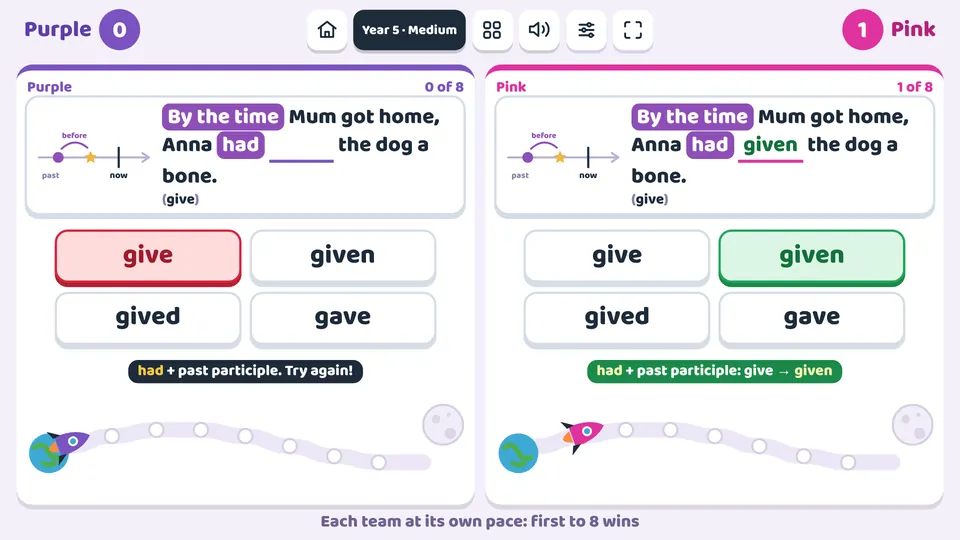
A game for learning English irregular verbs on the interactive whiteboard, in real sentences rather than lists. A sentence appears with a gap and a time clue: Yesterday we ___ to the park, She has already ___ her lunch, They had ___ home when the bell rang. A drawn timeline shows when it happens. Each team chooses the verb form out of four (go, went, gone and goed, which does not exist) and, if it is right, its rocket moves closer to the Moon. A wrong answer gets the rule, not the answer. You can also practise the three forms in a row (go, went, gone) and spell them letter by letter.
What children practise
- The past simple of irregular verbs: go, went; eat, ate; buy, bought
- To be and have in the present, past and past participle: am, is, are; was, were; been
- The past participle and when to use it: with have or has (present perfect) and with had (past perfect)
- Time clues: yesterday, last week, ago, already, just, ever, every day
- Adverbs of frequency (always, usually, often, sometimes, never) and where they go in the sentence
- The present simple with -s: she goes, he does, it flies
- The three forms of 67 verbs (go, went, gone) and spelling them correctly
Levels and settings
Year 3
How often?: always, usually, often, sometimes or never from the days ticked on the week and where it goes in the sentence, with be and have, and then with the 25 most common verbs.
Year 4
How often? with 25 and then 45 verbs; on hard, the past with yesterday or last week.
Year 5
The past of 25 and then 45 verbs, with four answers including one that does not exist (goed, eated); on hard, the three forms in a row (go, went, gone).
Year 6
The present perfect: have or has plus the past participle (has already eaten, have you ever ridden a camel?); then the three forms in a row and spelling the form letter by letter, with all 67 verbs.
Irregular verbs list to practise at home
The 67 verbs in the game, in the order worth learning them: first be and have, then the most common ones. Each group is the one you choose in the game (be and have, 25, 45 or 67 verbs).
| Verb | Past simple | Past participle | |
|---|---|---|---|
| be and have | |||
| 1 | be | was / were | been |
| 2 | have | had | had |
| The most common (up to 25) | |||
| 3 | go | went | gone |
| 4 | eat | ate | eaten |
| 5 | drink | drank | drunk |
| 6 | see | saw | seen |
| 7 | come | came | come |
| 8 | do | did | done |
| 9 | make | made | made |
| 10 | take | took | taken |
| 11 | give | gave | given |
| 12 | get | got | got |
| 13 | say | said | said |
| 14 | run | ran | run |
| 15 | sit | sat | sat |
| 16 | swim | swam | swum |
| 17 | sing | sang | sung |
| 18 | buy | bought | bought |
| 19 | write | wrote | written |
| 20 | read | read | read |
| 21 | find | found | found |
| 22 | fly | flew | flown |
| 23 | sleep | slept | slept |
| 24 | ride | rode | ridden |
| 25 | win | won | won |
| More verbs (up to 45) | |||
| 26 | wear | wore | worn |
| 27 | lose | lost | lost |
| 28 | cut | cut | cut |
| 29 | think | thought | thought |
| 30 | bring | brought | brought |
| 31 | catch | caught | caught |
| 32 | teach | taught | taught |
| 33 | draw | drew | drawn |
| 34 | break | broke | broken |
| 35 | speak | spoke | spoken |
| 36 | fall | fell | fallen |
| 37 | forget | forgot | forgotten |
| 38 | begin | began | begun |
| 39 | know | knew | known |
| 40 | throw | threw | thrown |
| 41 | leave | left | left |
| 42 | meet | met | met |
| 43 | feel | felt | felt |
| 44 | hear | heard | heard |
| 45 | put | put | put |
| The rest (up to 67) | |||
| 46 | grow | grew | grown |
| 47 | tell | told | told |
| 48 | sell | sold | sold |
| 49 | send | sent | sent |
| 50 | spend | spent | spent |
| 51 | build | built | built |
| 52 | hold | held | held |
| 53 | stand | stood | stood |
| 54 | understand | understood | understood |
| 55 | choose | chose | chosen |
| 56 | hide | hid | hidden |
| 57 | bite | bit | bitten |
| 58 | blow | blew | blown |
| 59 | drive | drove | driven |
| 60 | ring | rang | rung |
| 61 | hit | hit | hit |
| 62 | become | became | become |
| 63 | pay | paid | paid |
| 64 | keep | kept | kept |
| 65 | wake | woke | woken |
| 66 | feed | fed | fed |
| 67 | dig | dug | dug |
How to play it in class
- Choose the year and difficulty, or in More options the level, how many verbs (be and have, 25, 45 or 67), three or four answers, the voice and the points.
- Press Start: each team has the same sentence in its part of the screen.
- Find the time clue in the sentence and tap the verb form that fits. When it is right, the voice reads the whole sentence.
- Each right answer moves the rocket closer to the Moon. A wrong one shows the rule; after two mistakes the answer appears and a new sentence comes.
Ways to play
In teams, at the same time
The screen splits into 2, 3 or 4 and each team plays on its own part at the same time.
For one player
One child plays on the whole screen at their own pace: on the whiteboard, a computer or a tablet.
Frequently asked questions
Which verbs come up?
The 67 irregular verbs used most in primary school, starting with be and have, then go, eat and buy, up to understand and choose. You can play with be and have, the 25 most common, 45 or all of them. The full list is on this page and behind the Verb list button in the game, ready to print.
Does it cover adverbs of frequency?
Yes, in the How often? level: a week shows how many days someone does something and you choose always, usually, often, sometimes or never; you tap where the adverb goes (before the verb, after am, is, are) and choose the verb form (She always goes).
Why are there forms that do not exist, like goed?
Because it is the most common mistake: adding -ed to an irregular verb. Seeing it next to the right form helps children rule it out.
Is the past perfect too hard for primary?
It only comes up at Year 6 level. It always has had in front and a clue (when the bell rang, by the time), so knowing the past participle is enough.
Is it free?
You can play 5 free games without signing up. After that, a one-off payment of €9.99 unlocks all 100 games for ever, on all your devices. There is no subscription.
Do I need to install anything?
No. It opens in the browser of the interactive whiteboard, panel, computer, tablet or iPad. Once loaded, it also works offline.
More English games
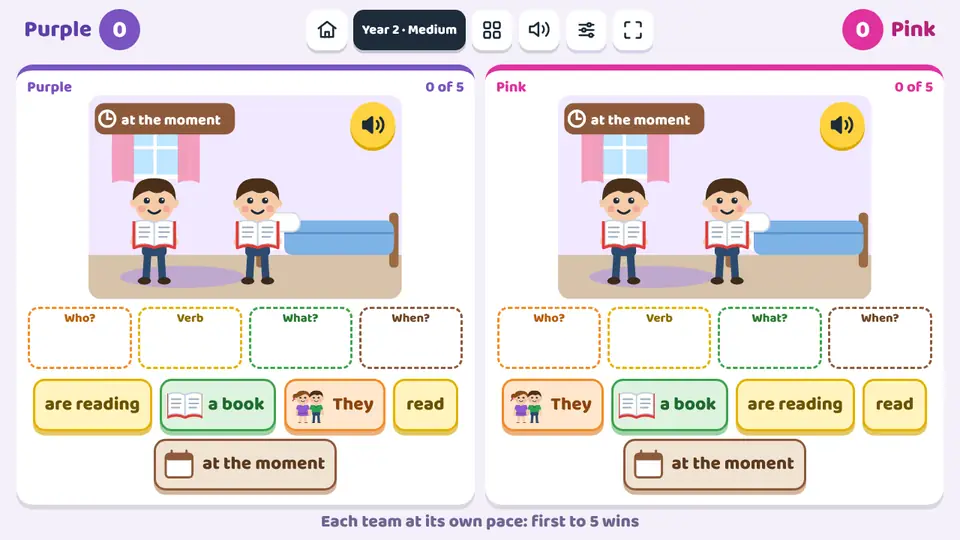 Past, present, futureIt is Sentence Builder for older children.
 Sentence BuilderIt starts from zero: the voice says a word or a sentence in English and children tap the matching picture, with no reading needed.
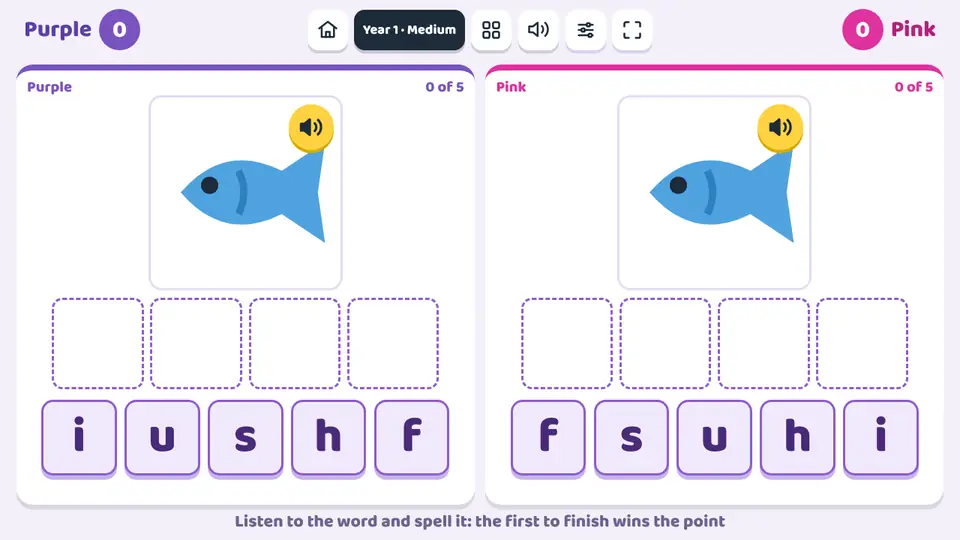 Spelling beeIn English schools spelling is practised every week and the spelling bee is its contest.
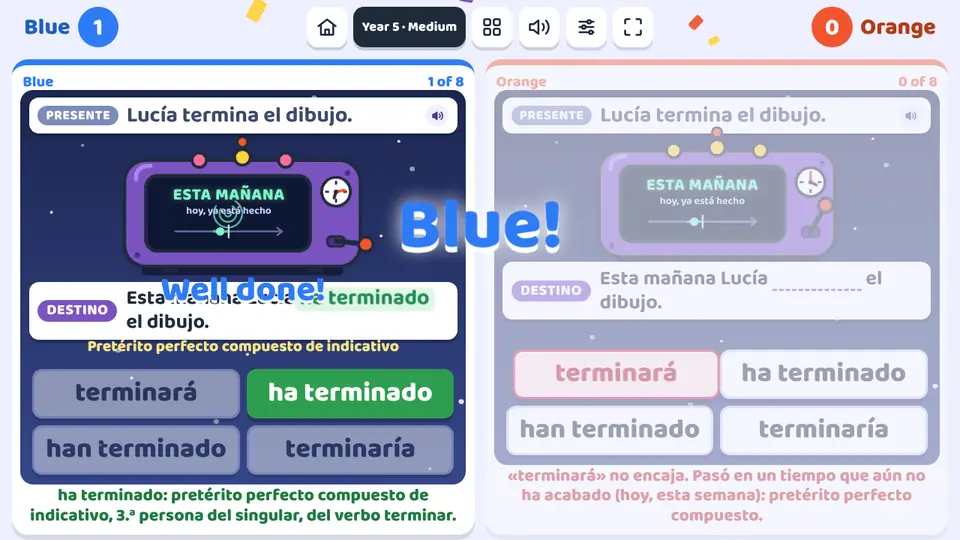 The time machineThe time machine is a Spanish grammar game for practising verb tenses on the interactive whiteboard or a tablet.
Irregular verbs
Play now