The two parts
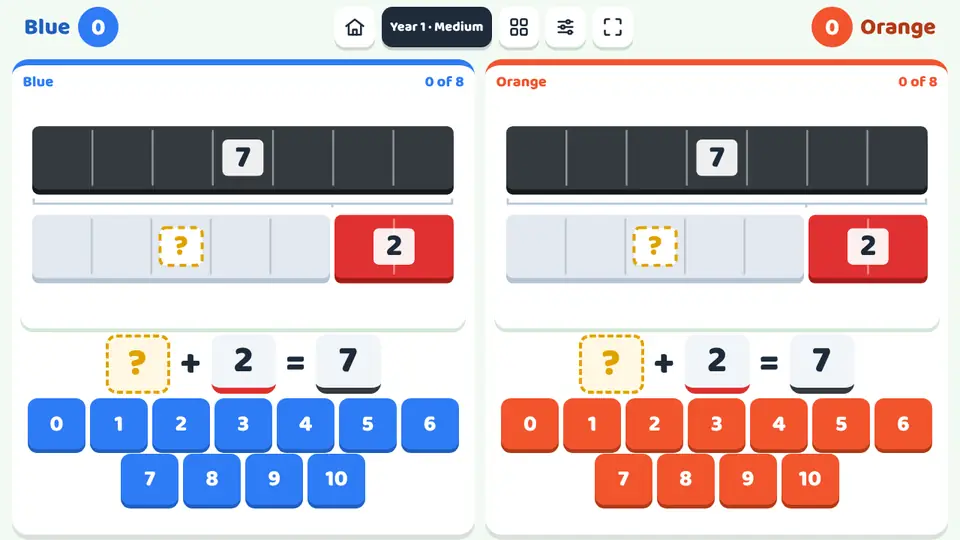
The two parts teaches number bonds with the part-part-whole bar model. The whole bar sits at the top with its two parts below, in the classic colours of number rods. One part, or the whole, is missing and shown in grey: complete the number sentence underneath by tapping the answer on the keypad. Get it right and the grey piece takes on its colour.
What children practise
- Partitioning a number into two parts with the part-part-whole model.
- Seeing addition and subtraction as inverse operations on the same bar.
- Finding the missing addend (3 + ? = 10) and what is left (10 − 3 = ?).
- Linking each number to its rod colour.
- Adding and subtracting multiples of ten and of one hundred, such as 40 + 30 or 300 + 400.
Levels and settings
Early years
Addition only, with a whole up to 5 or up to 10.
Years 1 and 2
Up to 10 and up to 20, adding and subtracting; in Year 2 on Hard, the bar shows colours only.
Years 3 and 4
From 20 it moves on to multiples of ten and, in Year 4 on Hard, of one hundred.
Years 5 and 6
Multiples of ten and one hundred, often with no numbers on the bar.
The family
Four number sentences with the same bar: 3 + 7, 10 − 3, then with the parts swapped, 7 + 3 and 10 − 7.
How to play it in class
- Open The two parts and choose the year and difficulty: the game sets the size of the whole and the kind of sum.
- If you like, change the operation (adding, taking away, both or the family), the numbers on the bar and the squares to count.
- Play in teams on a split screen, or with one child on their own.
- Look at the bar and tap the number that completes the sentence. After a mistake the game says: Look at the whole bar. The first to 5, 8 or 12 points wins.
Ways to play
In teams, at the same time
The screen splits in two and each team plays on its own half at the same time.
For one player
One child plays on the whole screen at their own pace: on the whiteboard, a computer or a tablet.
Frequently asked questions
Does it use rod colours?
Yes. Each number always has the same rod colour: 2 red, 5 yellow, 10 orange. From 11 to 20 the ten is shown in orange and the rest in the colour of the ones.
Why is the missing part grey?
So it cannot be guessed from its colour. Once answered, it appears with its colour and number.
Is it free?
You can play 5 free games without signing up. After that, a one-off payment of €9.99 unlocks all 78 games for ever, on all your devices. There is no subscription.
Do I need to install anything?
No. It opens in the browser of the interactive whiteboard, panel, computer, tablet or iPad. Once loaded, it also works offline.
More Maths games
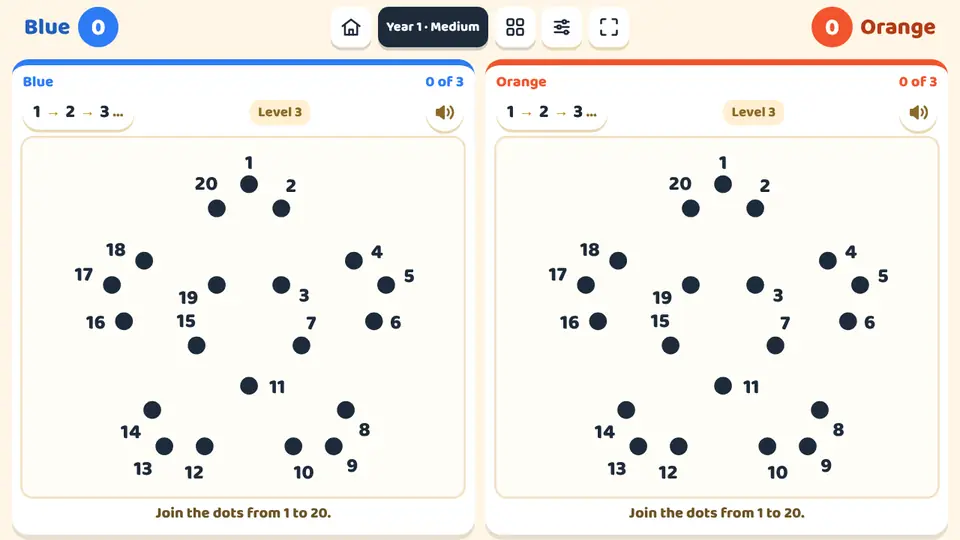 Join the dotsJoin the dots turns the number sequence into a picture.
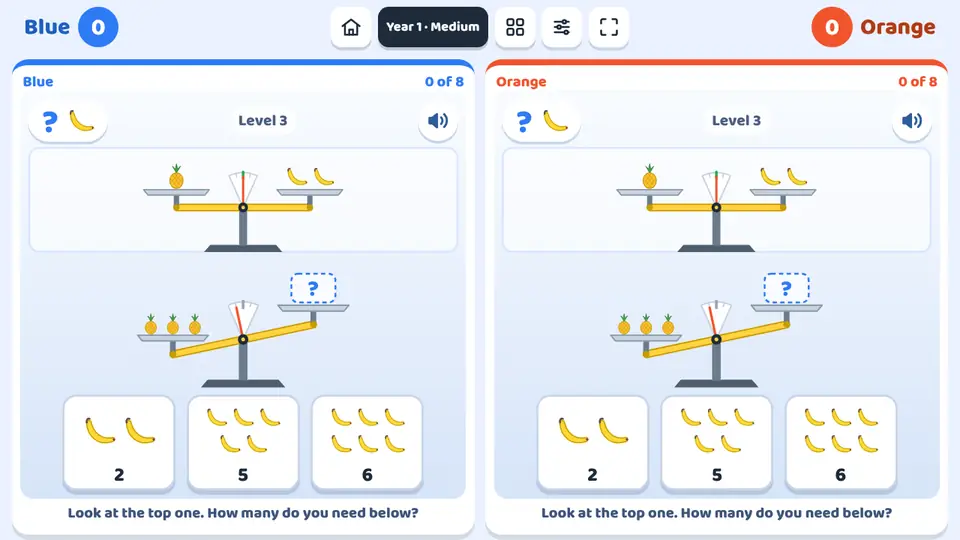 The scalesThe scales is a two-pan balance that tips towards the heavier side.
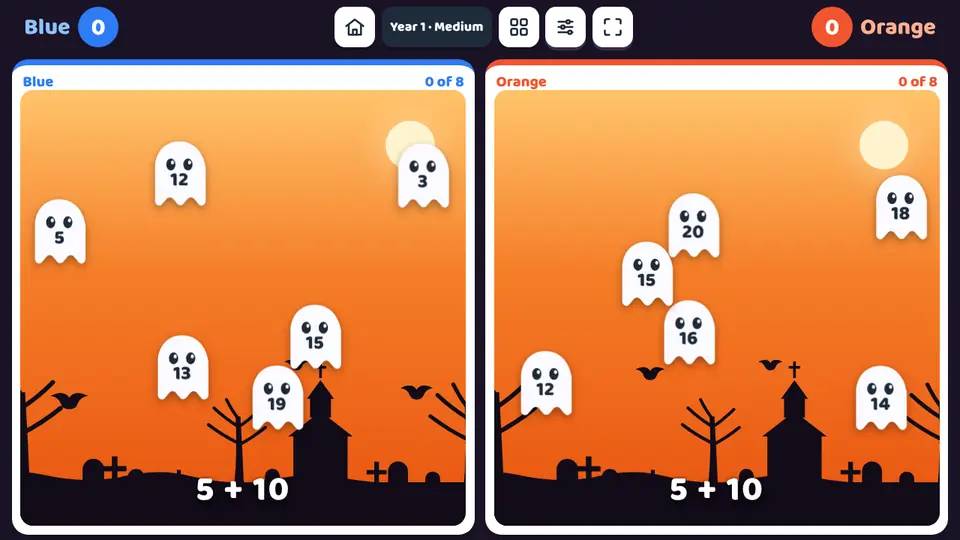 Catch the ghostIn Catch the ghost, ghosts drift over a graveyard and each one carries a number.
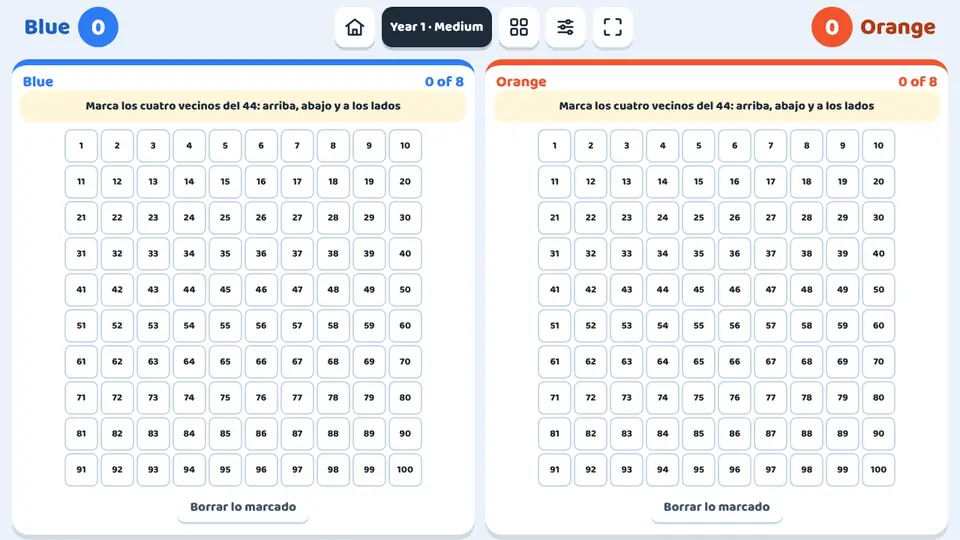 The hundred squareThe hundred square is the classic number grid, ready to use on the interactive whiteboard.
The two parts
Play now